
Provenance and flow you can quote in a case file.
Cali Graph is the provenance surface of the Cali Technologies investigation platform. It shows how value moves across wallets, services, chains, mixers, and bridges—and converts those paths into structured case narratives, not just visuals. Automated tracing across hops, services, mixers, and chains reduces manual reconstruction and missed connections.
For investigators, compliance officers, and law-enforcement teams, Graph is where provenance becomes documentation suitable for affidavits, SARs, and briefings.
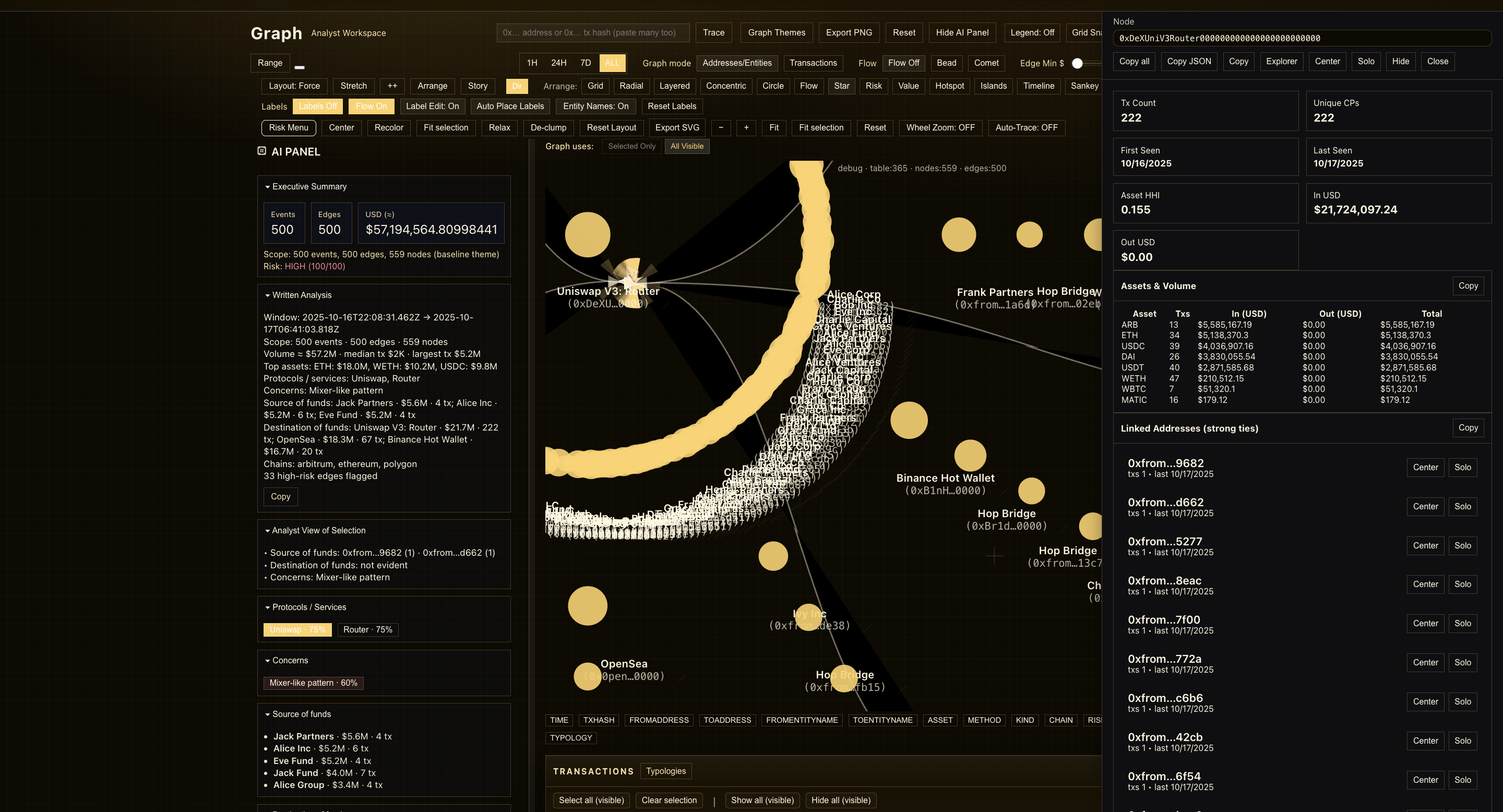
Tracing flows across mixers, bridges, hops, intermediaries, and cash-out points is time-consuming and error-prone. This module auto-traces and reconstructs provenance and highlights high-risk segments.
- Easily explainable flow paths
- Clear separation of victim funds vs unrelated movement
- Rapid mixer/bridge identification
- Exposure paths across wallets, services, bridges, and counterparties.
- Cross-chain movement and multi-hop flow structure.
- Mixer adjacency, intermediary wallets, and off-ramp paths.
- Provenance narratives that support case review and reporting.
- Multi-chain flow reconstruction
- Mixer/bridge detection
- Entity and risk overlays
- Select-mode for isolating suspicious paths
- Exposure view for inbound/outbound analysis
- Automated end-to-end flow tracing across wallets, services, mixers, bridges, and exchanges
A victim wallet sends funds through 3 intermediary hops to Tornado Cash, then to two separate exchanges. This module rebuilds the flow in seconds and marks the Tornado leg as high-risk with exposure percentages.
- Visualizes flows between wallets, entities, services, and contracts across chains.
- Highlights mixers, bridges, exchanges, and other intermediaries that matter to an investigation.
- Displays paths and clusters alongside the underlying transaction table from Activity.
- Helps teams explain where value came from, where it went, and what happened in between.
- Exchange and fintech compliance teams
- Banks and VASPs reviewing customer wallets and flows
- Crypto compliance & AML investigation teams
- Fraud, investigations, and recovery units
- Law-enforcement and public-sector forensic teams
The Cali Panel summarizes the same metrics the investigator sees—nodes, edges, entity hints, labels, and services in view—and proposes case narratives and provenance drafts for what happened in the flow.
- Summarizes provenance from a starting wallet or transaction to upstream sources of funds.
- Describes how value moves through mixers, bridges, DeFi protocols, and exchanges.
- Calls out notable intermediaries, clusters, and patterns relevant to a case.
- Produces draft language suitable for inclusion in reports, affidavits, and internal memoranda.
The system does not make the final decision; analysts remain in control. Structured drafts and summaries accelerate documentation and reduce cognitive load.
Graph is designed for a world where flows move across chains and services quickly.
- Supports major L1 and L2 chains with alignment to Activity, Balance, and Assets.
- Treats mixers, bridges, and DeFi protocols as first-class components in flows.
- Aligns with OSINT Intelligence for sanctions, PEP, and adverse-media context on entities in the graph.
- Continues to evolve as new services and patterns emerge.
This module typically sits alongside Activity and Pivot in an investigation. It is where teams move from "we see suspicious activity" to "here is how the funds actually moved."
- Start in Activity to identify transactions of interest, then move to Graph to understand provenance and flow.
- Use OSINT Intelligence to add sanctions, PEP, and adverse-media posture to key nodes.
- Bring everything into Investigative Reports when it's time to write up findings.
Show, don't tell, how the funds moved.
We recommend seeing Cali Graph on a real matter—victim funds, a fraud investigation, or a crypto exposure your team is already working. That's the fastest way to assess whether it meets your standard.